There is a version of the AI conversation in accounting that is mostly theater: a demo where a model reads an invoice, produces a journal entry, and everyone applauds. Then someone asks the only question that matters in this profession — how do you know it is right? — and the room gets quiet.
Accuprime is not an AI company. We are an accounting firm that has spent the last two years building software because our clients needed tools that did not exist. That work put us in an unusual position: we run month-end closes and we build the systems that produce the numbers. This is what we have learned about where agentic AI actually helps in a finance function, where it quietly creates risk, and what has to exist around it before it can be trusted.
The shift: from asking to acting
The distinction that matters is not "AI" versus "no AI." It is between a model that answers and a system that acts.
A chat assistant that explains an accounting treatment is an answer. It carries no consequence — a human reads it, judges it, and decides. An agentic system is different in kind: it takes a goal, breaks it into steps, calls tools, and produces changes in the world. Categorize this transaction. Match this payment to this invoice. Draft the accrual and post it. Email the variance summary to the controller.
That shift from answering to acting is where the value is, and it is exactly where the risk moves too. An answer that is wrong gets corrected in conversation. An action that is wrong lands in the ledger — and it lands at machine speed, dozens or hundreds of times, before anyone notices the pattern.
AN ACTION THAT IS WRONG LANDS IN THE LEDGER.
The gap: "the model decided" is not a workpaper
Every accountant reading this already knows the standard. When a lender, an auditor, an acquirer, or a regulator asks why a number is what it is, the answer has to be reconstructible: here is the source document, here is the treatment, here is who reviewed it, here is when. That chain is not bureaucracy. It is the entire reason financial statements mean anything.
Most AI deployments in small and mid-sized finance functions fail this test not because the model is unintelligent, but because the surrounding process was never designed to capture the chain. The specific failures we see repeat:
- Invisible decisions. The tool categorized 400 transactions this month. Nobody can say which ones it was unsure about, because it was never asked to express uncertainty.
- Confident wrongness. Language models do not fail loudly. A misclassified capital expenditure reads exactly like a correct one — fluent, plausible, and wrong in a way that surfaces two quarters later in a depreciation schedule.
- Silent drift. A workflow that was accurate in March degrades in June because a vendor renamed itself, a payment platform changed its export format, or the business started selling something new. Without monitoring, nobody notices until the variance is material.
- No stopping condition. The system was given a goal and tools, but never a boundary — no dollar threshold, no account whitelist, no rule that says stop and ask a human.
- Unreviewable trails. When the auditor asks how the number was derived, the honest answer is a chat log. That is not evidence.
None of these are arguments against using AI. They are arguments against using it the way most people currently are: as an unsupervised employee with no scope, no review, and no record.
The frame: the control layer is the product
Our working thesis, tested in the systems we have built and run in production, is that in a finance function the model is a commodity and the control layer is the product. The model will get better every few months regardless of what you do. The controls around it are what determine whether that improvement becomes leverage or liability. Five principles govern how we build:
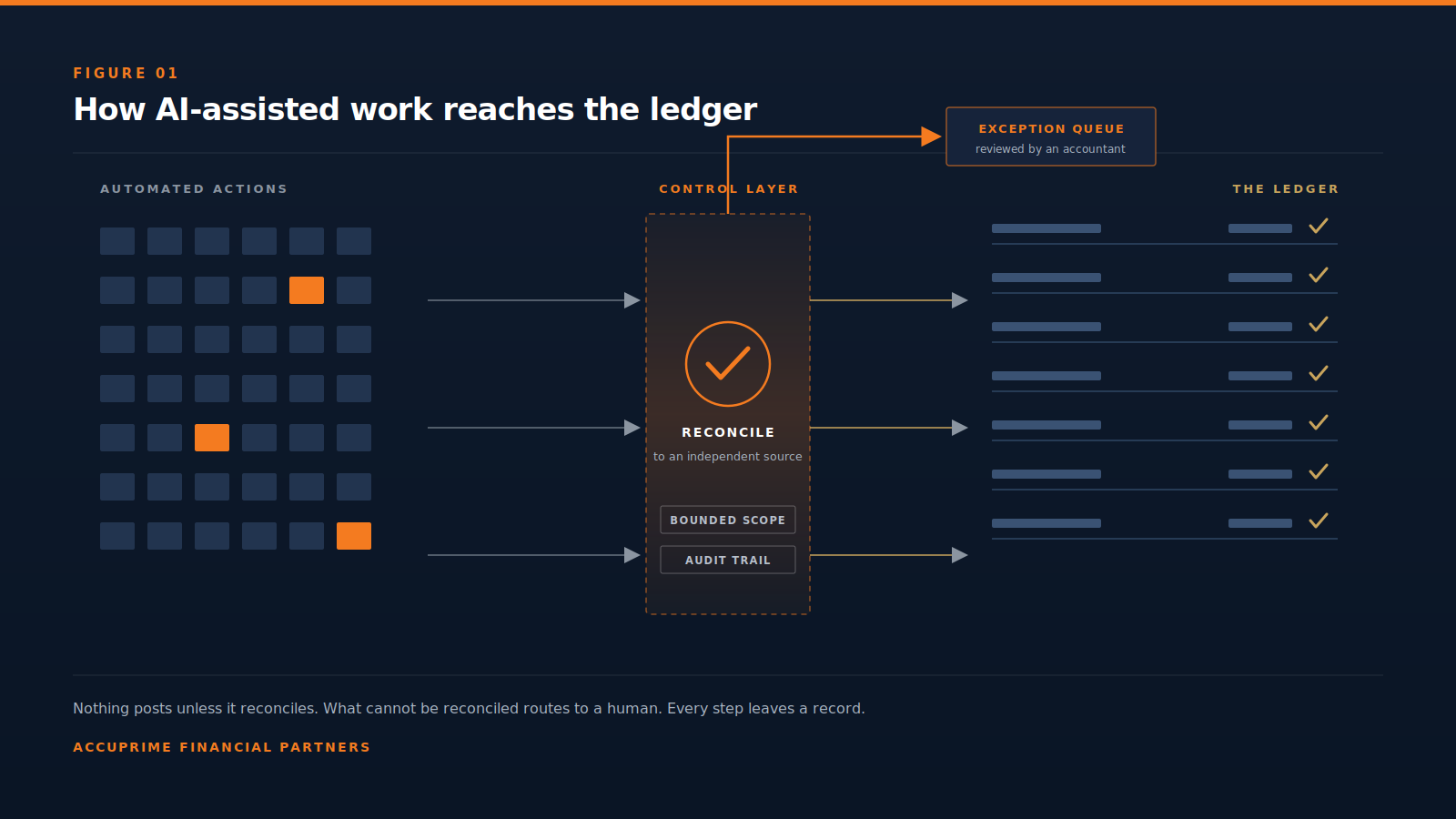
- 1. Reconciliation is the referee. Every AI-assisted output must tie to something independently verifiable — a bank feed, a payroll register, a payment processor report. If the automation and the source do not agree to the dollar, the automation is wrong until proven otherwise. This is the oldest control in accounting and it is the one that makes AI safe.
- 2. Bounded authority, always. Agents get explicit scope: which accounts, which dollar thresholds, which transaction types, and what to do when confidence is low. Anything outside the boundary routes to a human queue. A system that cannot say "I am not sure" should not be allowed to post.
- 3. Every action leaves a record. What was proposed, what evidence supported it, what the system did, who approved it, and when. Not a chat log — a structured audit trail that a reviewer can follow in sequence. If it cannot be shown to an auditor, it does not ship.
- 4. Humans review the exceptions, not the volume. The purpose of automation is not to remove judgment; it is to concentrate it. Our accountants stop scrolling through 400 clean transactions and spend their attention on the twelve that are ambiguous — which is the work that was always worth paying for.
- 5. Monitor for drift, permanently. Accuracy is measured continuously against reconciled outcomes, not validated once at launch and assumed forever. Systems degrade quietly; only measurement makes that visible.
THE CONTROL LAYER IS THE PRODUCT.
What this looks like in practice
The platforms we have built are not AI products, and that is deliberate — but they are the reason we hold these views. Liaison Flow, our patient outreach and commission platform running across 21 healthcare clinics, automates the parts of the workflow that are rule-shaped: queueing, logging, alerting, nightly reporting. Every commission it calculates reconciles to a verified visit. FluxWage, the payroll engine we built for offshore crew rotations, encodes rules no vendor supported — and every run reconciles against the register before anyone is paid.
That is the discipline we carry into AI-assisted work. Automation earns trust by reconciling, not by sounding confident. The same standard applies whether the logic came from a rules engine we wrote or a model we prompted.
Where we think this goes
Three predictions we are willing to be judged on.
- Transaction processing becomes assisted by default within a few years. The routine categorization and matching work that fills a bookkeeper's day is genuinely well-suited to agentic systems operating inside reconciliation boundaries. Firms that pretend otherwise will compete on price and lose.
- Review and judgment become the profession's center of gravity, not its overhead. When volume work compresses, the scarce skill is the person who knows which twelve transactions to question, what a strange margin movement implies, and how to explain it to an operator making a decision. That is not automatable — it is the job.
- Audit trails become the competitive line. The firms that can show exactly how an AI-assisted number was produced will pass lender and buyer diligence smoothly. The firms that cannot will discover the problem at the worst possible moment: mid-transaction, under scrutiny.
Our position, stated plainly: we use AI where it demonstrably reduces error and cost, we govern it with reconciliation and human review, and we do not put anything in front of a client that we could not defend line by line to an auditor. If a tool cannot survive that test, it does not touch client books — regardless of how impressive the demo was.
If you are evaluating AI in your own finance function, the questions worth asking a provider are not about which model they use. Ask what it is allowed to do without approval, what it reconciles against, what happens when it is uncertain, and what record it leaves behind. The answers will tell you everything.